From withdrawal to leverage

Boycott-to-Lobby™

A boycott used to mean walking away and hoping. Boycott-to-Lobby™ keeps the withdrawal and adds the three things it never had: a demand, a deadline, and a way back. We respect what boycotts have built. This is what comes next.

The short version

A horn, a megaphone, or a broadcast node.

A traditional boycott is the handheld horn. It makes your refusal audible, and it carried every major campaign of the last century. We honor that. Most of us learned to speak through that horn.

The organized boycott is the amplified megaphone: louder, themed, targeted, coordinated in days. It already exists, and it already works.

Boycott-to-Lobby™ is the broadcast node: the same voice, wired into the machinery that actually writes policy, through one demand: publicly support named civilian-protection legislation, verifiable in your quarterly lobbying disclosures. The first two make you louder. The third makes you heard where it counts.
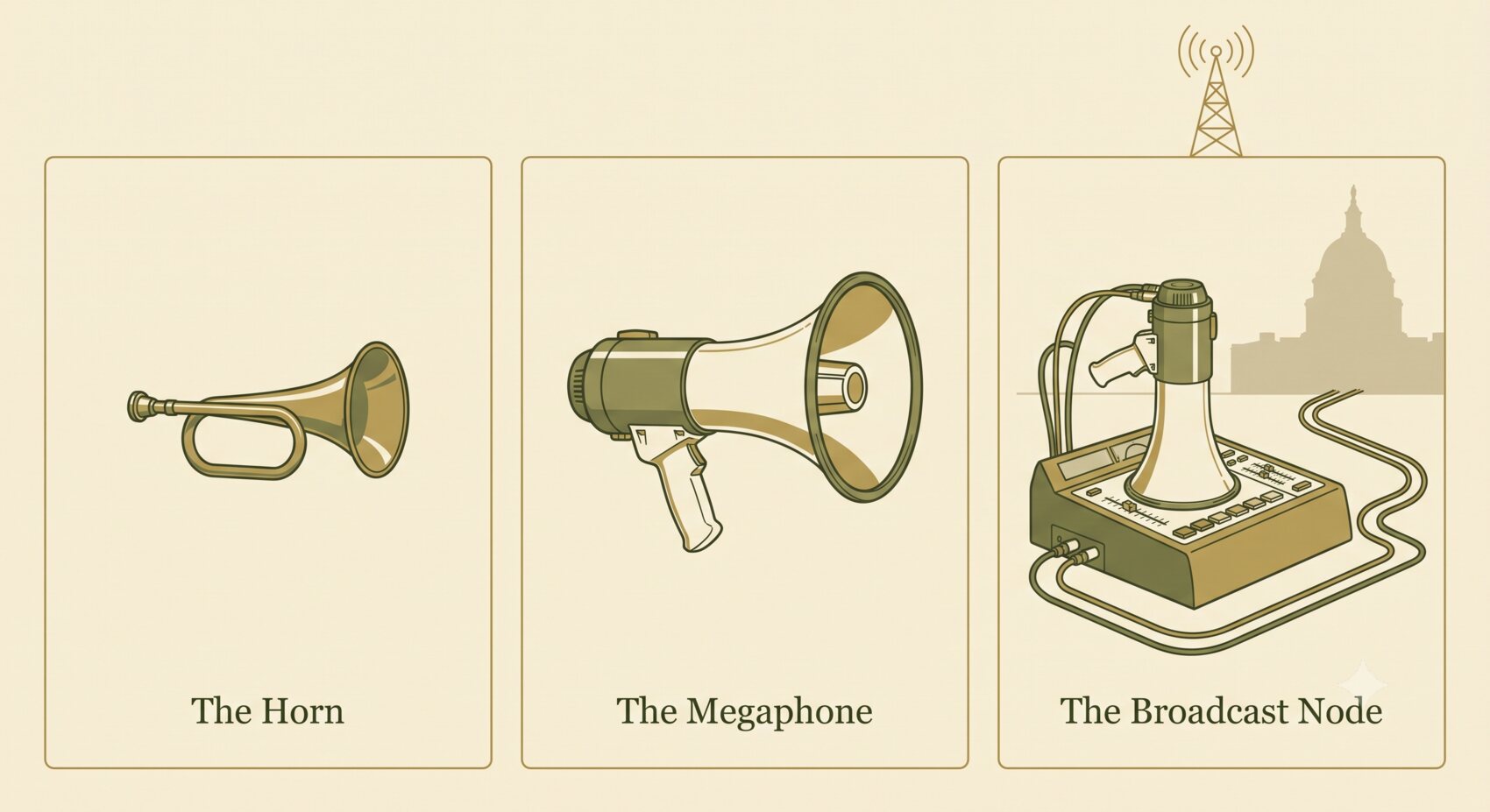
Three-stage illustration: a simple handheld horn, an amplified megaphone, and a networked broadcast node

We keep reaching for the handheld horn while the broadcast node sits on the shelf.
Why now

The tools finally exist. The boycott never used them.

For most of history, mass mobilization arrived late, because coordinating people was slow and costly. That constraint is gone. A walkout or a sit-in can now be organized and carried out in minutes. Yet the boycott, advocacy’s most economic tool, has barely changed. It still asks people to withdraw, and hope.

The missing ingredient is not scale. It is story. The historian Yuval Noah Harari argues that shared narratives, more than material facts, are what move large numbers of people to act together. A boycott with a protagonist, a deadline, and a resolution behaves less like a protest and more like a cause people want to join. The recent boycotts of Starbucks and McDonald’s proved how fast a shared story can pull millions to withdraw at once, and how directly that lands on an earnings call.

We begin with the engagement ring: a high-ticket purchase couples can defer or switch tomorrow, because the substitute is chemically identical and costs 60 to 80 percent less.
Side by side

Same conscience. Different machinery.

Traditional boycotts, with BDS as the most recognizable, built the consumer consciousness every campaign now stands on. We're not replacing them, and we don't claim to be better. We're the next gear on the same engine.

Hover over a circle. On a phone, tap it.
“Unlike the often unyielding stance of classic boycotts, Boycott-to-Lobby offers embattled corporations a pathway to redemption and a practical ‘stop-loss’ strategy … This pragmatic approach does not claim superiority over BDS but highlights our unique strategy, finding a critical intersection between institutional influence and consumer power.”
Why we offer a way out

A surgeon doesn't discard the organ. They remove the cancer.

When a surgeon finds malignant cells, they don't throw away the whole organ if they can target the disease and cut it out precisely. The organ gets to live, healthier than before.

We feel the same way about the brands people love. The coffee you grew up on, the platform where your friends live, the store your family shops at: these companies are not the disease. The disease is where a slice of their money goes: lobbying budgets that fund harm to civilians. So instead of demanding the corporation cease to exist in our lives forever, we go to their management and shareholders directly, publicly, and with deliberate spectacle, and say: here is the wrong, here is the correction, here is the deadline. Cut the malignancy out, and keep your customers.

It's smarter and faster for us as organizers, and it's financially rational for them. A corporation watching its market share bleed doesn't need a lecture. It needs a stop-loss. We are the only ones offering one.

Before a single boycott begins

Nothing launches on instinct.

A boycott the public does not respect will not hold. So every campaign is engineered before it is ever announced.

Studied

Modeled in advance

We map the target’s financial exposure, its likely responses, and the point where a demand is both meaningful and winnable.

Simulated

Scenario-tested

We model likely reactions before launch, and are exploring lightweight simulation, potentially AI-assisted, to sharpen where the demand should sit. An approach we intend to develop with academic partners.

Fair

Designed to be respected

Demands are sized so the vast majority of consumers see them as fair. If a company moved five million dollars while still funding far more harm, no one would stand down, and they would be right not to.

Aligned

Coordinated exits

We coordinate with existing boycott institutions so a company that complies is removed from boycott lists cleanly. Our demands are built to meet the standards those campaigns set, not to compete with them.

The lifecycle

Every boycott we start is designed to end.

That sentence would sound strange coming from a protest campaign. It's the most important sentence on this page.

01

One target, one demand, one deadline

We name the corporation, publish the specific benchmark (for example: redirect a defined percentage of the annual lobbying budget toward civilian-protection legislation), and start a public countdown. The demand is never slipped quietly into a corporate mailroom. It lands as a spectacle: an open letter, a countdown clock, coordinated creators, cameras. Quiet letters get filed; public demands get meetings.

02

Coordinated pressure, publicly scored

Consumers withdraw together, creators publish together, and every week the scoreboard shows exactly what the refusal is costing. The company's leadership always knows where the exit is.

03

The choice

Management and shareholders see the math and choose: keep bleeding market share, or redirect money they were already spending on lobbying toward protecting civilians. We're not asking them to donate. We're asking them to re-aim.

04

Redemption, in full

If they meet the demand, we don't quietly stand down. We campaign as loudly to end the boycott as we did to start it. We publicly certify compliance, petition the relevant boycott institutions to remove them from their lists, and invite our entire community back through their doors. A corporation that proactively chooses the right values gets the full reward for it.

05

Or: escalation

If the deadline passes unmet, the pressure doesn't fade with the news cycle. It escalates on a published schedule, and every company watching learns exactly what refusing costs.

The leadership we reward

Some leaders already chose the right side. On purpose.

Boycott-to-Lobby™ is not built to punish companies. It is built to give them a reason, and a way, to do what the best of them already do without being asked.

Lush · Mark Constantine

He closed the doors, and meant it.

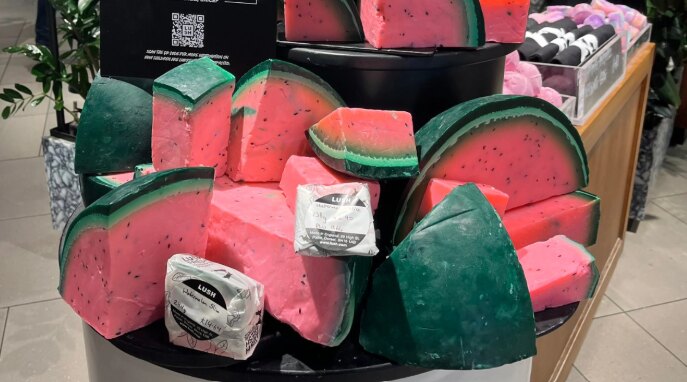
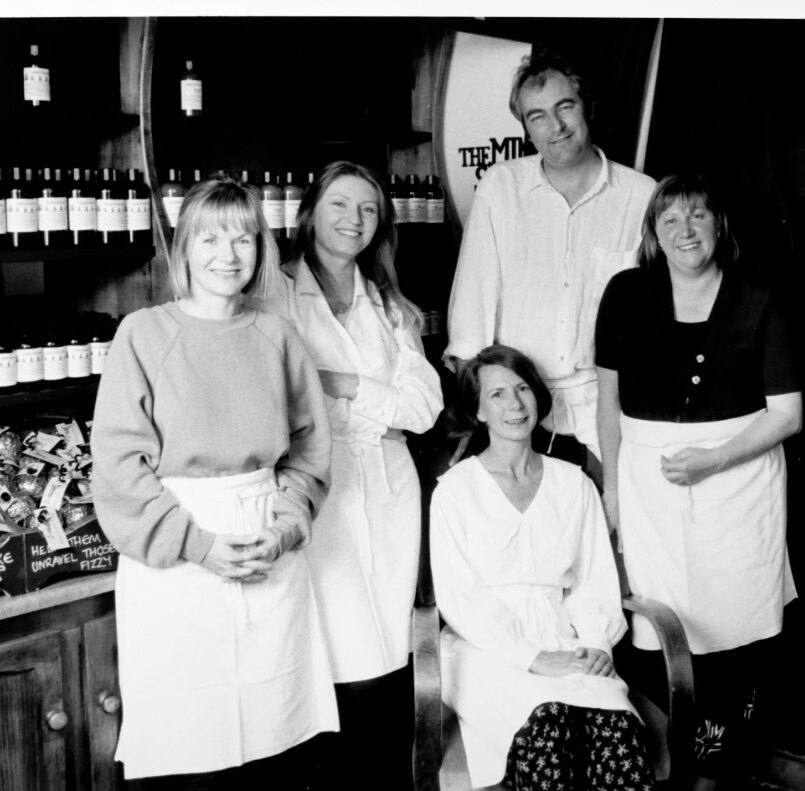
The founding team of Lush in their first shop Lush watermelon-slice soaps on display in store

Lush shut every UK store, its factories, and its website for a full day in solidarity with Gaza, windows reading “Stop Starving Gaza.” Co-founder Mark Constantine absorbed a loss near 300,000 pounds and told objecting customers plainly not to come back, saying he would use the remaining profit to do more of it. A leader who treats conscience as strategy.

Ben & Jerry’s · Ben Cohen

He was willing to be arrested.

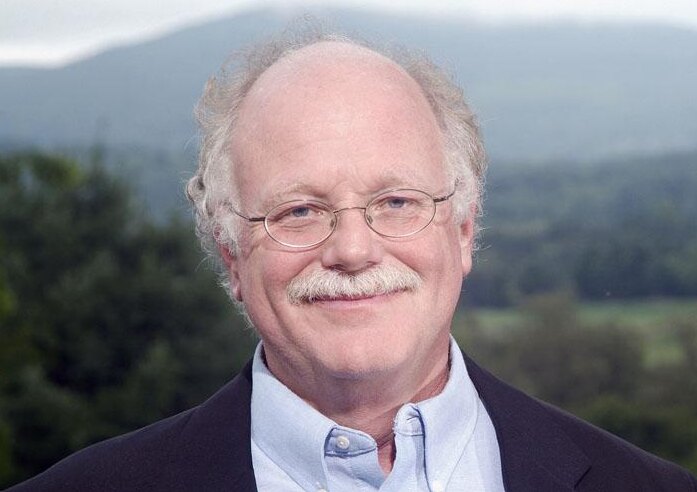
Ben Cohen, co-founder of Ben and Jerry's

Ben Cohen, co-founder of Ben & Jerry’s, was arrested disrupting a US Senate hearing to protest the funding of the war, saying Congress pays for bombs abroad while cutting children’s healthcare at home. Decades in, he still puts his body where his values are.

This is what a healthy society looks like. Boycott-to-Lobby™ simply makes it the profitable choice for everyone else.

What this means for you

You're not asked to hate the brand. You're asked to help save it.

Joining one of our boycotts isn't a lifetime vow, and it isn't an act of rage. It's a bounded, organized, measurable action with a clear win condition. You give up a product for a season, alongside thousands of others, so that a corporation's board is forced to look at one line in their budget and move it.

When they move it, you go back. That's not a compromise of your values. It is your values, executed. The point was never to destroy a company people love. The point is a world where the biggest brands in America compete to be on the right side of history, because their customers made it the profitable side.

You pause your spending to get their attention. They move lobbying money toward protecting civilians to win you back. That is the entire model.